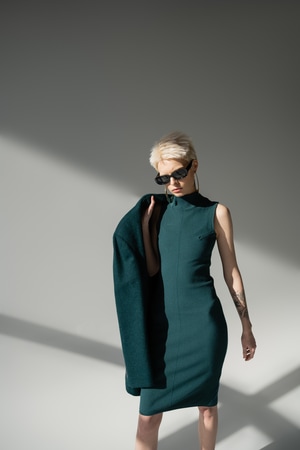
Although my mom didn’t say anything directly, I knew what she meant. As soon as I stepped off the train in Eugene after being gone from Portland for three years, my mom gazed at me and said, “You look very…Portland.” I wasn’t sure if she meant it as a compliment. I was wearing what I considered a totally normal Tuesday outfit — high-waisted vintage Levis, an oversized thrifted blazer, Doc Marten boots that I had saved up for months to purchase, and a canvas tote bag covered in a variety of colorful enamel pins. In Portland, I fit right in with the rest of the coffee shop crowd. Back in Eugene, however, I may as well have carried a sign saying, “I left for the big city and now drink oat milk lattes.”
As I stood in the Eugene train station while my mom silently evaluated my clearly Portland-themed outfit, I realised something I hadn’t thought about before — every city has its own style vocabulary, and I had inadvertently learned to speak the Portland dialect.
This isn’t simply a matter of different fashions, you know? It’s like two completely different attitudes toward dressing. What looks perfectly normal in Portland can come across as try-hard in another city. What is considered formal in one place doesn’t register as “I made an effort” in another. And I’ve been learning this the hard way — one awkward homecoming at a time.
Since I began working and visiting friends in various parts of the Pacific Northwest — Seattle, Eugene, and some smaller Oregon towns — I have developed a strange internal map of the regional fashion differences. This is entirely unscientific and primarily based on my observations while people-watching in coffee shops and vintage stores. So, consider it with a grain of…well, probably some artisanal sea salt from the Portland Saturday Market.
To begin, let me talk about Portland, because that is where I spend most of my time bemoaning rent prices and defending why I enjoy living in this town. There is an underlying philosophy of Portland fashion that says you should look intentional but not like you tried too hard. It is a delicate balance between “I care about how I look,” and “but I’m too cool to admit it.” Most everybody is wearing vintage or second-hand items, but they’re styled in such a way that, inexplicably, costs more than you’d expect.
For example, I have spent $40 on a vintage band t-shirt at a curated vintage store when I could have bought essentially the same thing at Goodwill for three dollars. However, the Goodwill version wouldn’t have had that perfect slightly faded look or the story of how the shop owner found it in an estate sale in Laurelhurst. Portland fashion is more about the story behind the pieces than the pieces themselves.
Additionally, everyone dresses like they may have to bike somewhere at a moment’s notice, even though they may have driven to where ever they are. Practical shoes, layers that you can shed, and bags that can actually carry things. A friend of mine named Jake, who moved here from LA, asked me, “Why do people here look like they are prepared for a hiking emergency, but also like they work in a design firm?” Honestly? That’s Portland in a nutshell.
The common thread that ties together Portland fashion, despite the fact that there are different tribes — the Hawthorne vintage crowd, the Pearl District minimalist crew, the Alberta arts community group — is an understanding that your clothing sends a message about your values. Do you support local designers? Do you shop second hand? Are you avoiding fast fashion? Clothes aren’t just clothes here. They represent a whole set of ethics.
At a recent meeting of my graphic design clients in Vancouver, Washington (which I know isn’t Oregon, but it is essentially Portland’s suburbs), I was thrown off. I never know whether I should be dressing Portland-hippie/bohemian/entrepreneurial, or professional.
One of the most interesting aspects of the regional style in the Pacific Northwest is how easily you can tell which city someone comes from. I can tell the difference between Portland transplants in Eugene immediately. They’re the ones dressed in perfectly curated “effortless” outfits to grab a coffee. I can tell the difference between Seattle tech professionals and Portland freelance designers. There’s something about the combination of the items, the amount of effort involved in putting them together, the price point of the “casual” items that gives it away.
I believe the pandemic did blur some of the regional style lines. We’re all wearing more comfortable clothes, we’re all buying clothes online rather than at local boutiques, and we’re all being influenced by the same TikTok fashion trends no matter where we live. But still, there are still distinct regional style differences.
What fascinates me the most is how our regional fashion identities follow us around. My Portland accent (okay, I don’t have a Portland accent, but you get the idea.) When I go home to Eugene, I subconsciously dress more comfortably. I’m less worried about telling a story with each item of clothing, I’m more concerned with just looking decent and comfortable.
I noticed this most starkly when I bumped into my old coworker from the campus bookstore, Meredith. She’s lived in Portland longer than I have. She works for a sustainable fashion startup. Normally, she looks so effortless cool that I feel like a tryhard compared to her. But I bumped into her at the Eugene farmers market when we were both visiting family, and she was wearing basic jeans, a basic sweater, and minimal jewelry – her “home” outfit.
“I couldn’t wear my Portland clothes in Eugene,” she said when I pointed out how different she looked. “My parents would ask too many questions about how much everything cost. Plus, what’s the point? I’m just hanging out with my high school friends who have known me since I had braces and terrible bangs. Who am I trying to impress?”
Exactly. And that may be the key difference in regional fashion around here – who we are dressing for and why. Portland’s creative, transient population allows us to dress for people we haven’t met yet, and for the identity we wish to portray in a city full of people who are all trying to reinvent themselves. In smaller communities, we are dressing for people who already know us beyond our wardrobe.
Both methods have their freedoms. Portland’s anonymity and creativity allow for more experimentation and the ability to test different aesthetic personas using thrift store finds and vintage clothing. But there is also something grounding about the way fashion functions in areas where your history is already known — where your wardrobe is merely one element of how people perceive you.
I enjoy recognising these variations as I travel around Oregon and Washington for work. The subtle changes in what is considered everyday wear, what is perceived as trying too hard, and what is viewed as acceptable and what elicits eye rolls. These variations serve as a type of secret code that reveal so much about the local values and priorities of the different communities.
The next time you are traveling between coastal cities, take a few minutes to observe the people and note these variations. The way Portland emphasizes authenticity and sustainability narratives. The way Seattle combines practicality with tech money polish. The way smaller towns maintain their own view of what looks good, without concern for whether it is trendy.
Regional style variations are truly cool — proof that despite Instagram and fast fashion attempting to create a single uniform style for everyone, local character continues to shape how we express ourselves. And yes, I still dress differently when I go home to Eugene. My mom still occasionally glances at me and says, “You look very Portland,” in a tone that implies it’s not entirely a compliment. But, honestly? I’m beginning to take it that way. Learning to communicate in the different regional style vocabularies is a skill. It indicates that you understand where you are and where you came from. Even if where you came from had cheaper coffee and way fewer enamel pins. END_TEXT.1. What I Find Interesting About Regional Style in the PNW
I find the regional style in the Pacific Northwest interesting because of how easily you can tell which city someone comes from. I can tell the difference between Portland transplants in Eugene immediately. They’re the ones dressed in perfectly curated “effortless” outfits to grab a coffee. I can tell the difference between Seattle tech professionals and Portland freelance designers. There’s something about the combination of the items, the amount of effort involved in putting them together, the price point of the “casual” items that gives it away.