When I wore a mustard yellow beret, a belted camel coat with oversized tortoiseshell buttons and loafers with mismatched socks to brunch last month with my friend David, he immediately knew what I was doing. He looked at me and laughed and said “Oh, so you’re trying to channel the less troubled younger sister of Margot Tenenbaum?” I tried to protest – I didn’t want to look like I was channeling a character from a quirky independent film, I just really loved the outfit – but before I could get the words out of my mouth, I caught sight of myself in the window of the restaurant. I couldn’t believe it – he was absolutely right. All I would need to do to complete the transformation was frame myself evenly and add a completely deadpan expression. I had accidently Wes-Andersoned myself.
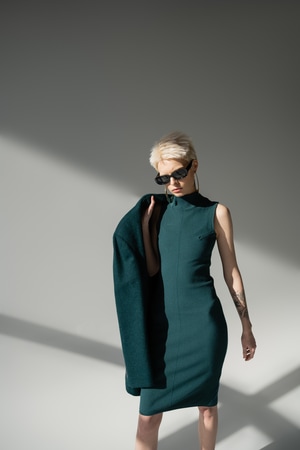
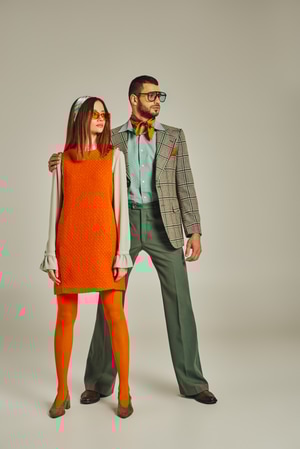
And I’m not alone. Look at your Instagram feed or walk through certain neighborhoods in major cities (Greenpoint, I’m talking to you!), and you’ll see them instantly – people dressed like they’re waiting for a vintage train to take them to a precocious spelling bee at a pastel colored resort run by Bill Murray. They wear berets and barrettes, knee socks with loafers, tweed blazers with elbow patches and round wire-rimmed glasses. Their colour palette stays inside a very small range of muted yellows, rust orange, forest green and burgundy. Everything is slightly too short or slightly too long. Nothing is ever regular sized.
The Wes Anderson aesthetic has broken free of the confines of film and has made its way into our closets and we can’t say we’re upset. However, we are curious. Why is everybody dressing like they’re trying out for “The Royal Tenenbaums: The Musical” all of a sudden? And why now, when Anderson has been creating visually distinct films for over twenty years?
“Fashion always draws inspiration from visual culture,” states Dr. Melissa Torres, a professor of cultural studies at New York University who teaches a class called “Fashion in Film.” “What is fascinating about the Wes Anderson influence is how specific and identifiable it is. You can point to somebody and say ‘that’s Wes Anderson core’ the same way you could say ‘that’s punk’ or ‘that’s prep.’ It has created its own distinguishable aesthetic category.”
The identifiable Wes Anderson look is based largely off of prep school uniforms, the colours and patterns of the mid-century, European sensibilities and vintage sportswear. It is at once nostalgic and timeless, whimsical yet precise, and different enough from other styles to be identifiable without being outrageous. While Anderson has been developing this aesthetic since Rushmore in 1998, it has only been in the past year or two that it has exploded as a mainstream fashion influence.
The timing makes sense when considering our current cultural environment. When the world can feel so chaotic and unpredictable, the carefully crafted and ordered world of a Wes Anderson film is appealing because it represents order, intention and the idea that there is someone directing the scene with precision.
“There is something reassuring about the control in Anderson’s aesthetic,” states Maya Lin, a costume designer who has worked on several independent films. “Every detail is thought out. There is nothing accidental. We have been living in a time of great uncertainty – pandemic, politics, climate etc. – and there is something soothing about looking like you fit into a world where everything has its place.”
TikTok has also been a significant factor in the spread of the aesthetic. The hashtag #WesAndersonAesthetic has over 500 million views. Users share images of outfits, home decor ideas, and scenarios where they imagine their lives as a Wes Anderson film. The algorithm pushes the video to anyone who has expressed interest in vintage clothing, independent films or quirky personal style, thus creating a self-reinforcing circle of Anderson inspired content.
Additionally, in 2023, TikTok users began filming mundane locations – laundromats, libraries, convenience stores – in a symmetrical and colour-coordinated style, similar to Anderson’s cinematography. Suddenly, everyone was viewing the world as if they were watching a Wes Anderson film. Fashion followed.
However, the Wes Anderson aesthetic is not just about nostalgia or escape – it’s about creating characters. Anderson’s films are filled with immediately recognizable characters who define themselves by their distinctive wardrobes. Think Margot Tenenbaum’s Lacoste dresses and blunt bob, Suzy Bishop’s pink dress and binoculars in Moonrise Kingdom, or the matching uniforms of The Grand Budapest Hotel. Each of these characters knows who they are and dresses accordingly. In a time when many of us feel lost and unsure of our own identities, that confidence is appealing.
“When you incorporate elements of the Wes Anderson style into your wardrobe, you’re essentially costume designing your own character,” states Torres. “You’re saying, ‘this is who I am in the movie of my life.’ This is a way of using clothing as a method of telling your own personal story.”
I can relate to this. Sometimes, when I feel especially uncertain or anxious, I reach for clothing that feels more intentional, more structured. Clothing that feels like armor against chaos. My most Wes Anderson-esque items (the mustard beret, a tweed blazer from a vintage store in Paris, saddle shoes I purchased on a whim and wear far more often than I anticipated) provide a feeling of being the main character, whether I’m walking down the street or sitting alone in a coffee shop.
Recently, I decided to attempt to emulate the aesthetic more intentionally, instead of accidentally. I wanted to explore how I would feel when I deliberately embodied the look. So, I put together a full-on Wes Anderson inspired outfit, including a pleated tennis skirt, knee socks, penny loafers, a button-down shirt with a Peter Pan collar, and a cardigan draped over my shoulders. I finished the outfit with a velvet headband and a pair of glasses. Overall, the combination felt like a cross between the image of a precocious private school student and an eccentric young widow with a dark secret.
The reaction was instant and varied. The barista at my local coffee shop, who typically ignores my existence except to serve me my coffee, smiled and said, “I love your entire vibe today.” A woman on the subway asked where I purchased my skirt. My editor, when I arrived at our meeting, simply said, “Rushmore?” and I nodded. That was it.
However, the most surprising result was the way the outfit affected how I moved through the world. I found myself standing taller, speaking more deliberately, and – I swear this is true – I experienced a strong urge to position myself in the centre of doorways and gaze pensively into the middle distance. The clothes did not just function as clothes – they directed me to portray a particular character in the film of my day.
“That is the true value of aesthetically distinct looks like Anderson’s,” states Lin. “They are not just visual – they are behavioral. Clothes make demands on how you move and interact.”
Of course, not everyone can or wishes to emulate the entire Wes Anderson aesthetic in their daily lives. The aesthetic requires a willingness to abandon practicality (knee socks are not the ideal choice for most office environments) and may venture into costuming territory if carried to extremes. Many people, however, are incorporating elements of the aesthetic into their wardrobes in more subtle ways – a pair of round glasses, a whimsical brooch, or simply a more thoughtful consideration of colour coordination.
“You don’t have to wear head-to-toe Margot Tenenbaum,” suggests Parker Lee, a stylist who has worked with several indie musicians who are embracing the aesthetic. “It’s more about the spirit – a little whimsy, a little nostalgia, and clothing that tells a story about who you are.”
High-end fashion has also taken notice of the trend. Miu Miu’s recent collections could easily dress an Anderson film, with their blend of vintage-inspired silhouettes, quirky accessories and distinctive colour palettes. Under Alessandro Michele, Gucci has adopted the eccentricity and layered storytelling inherent in Anderson’s visual universe. Even more minimalistic brands such as The Row have adopted elements of Anderson’s precision and intentionality – although not his whimsy.
However, the most creative interpretations of the aesthetic are emerging in vintage and second-hand communities. Since Anderson’s own visual references draw primarily from earlier eras — the 1960s, 1970s and 1980s — shopping for vintage clothing is the perfect means of gathering authentic Anderson-inspired pieces.
“My best Anderson-inspired pieces are all vintage,” affirms Lee. “A 1960s Pendleton jacket, a pair of saddle shoes that were made in the 1970s and still have tags attached, French school girl barrettes from the 1980s. They have the patina of actual experience that makes them feel like character pieces rather than costumes.”
Additionally, the connection to vintage and second-hand clothing provides a sustainable aspect to the trend that appeals to environmentally-conscious consumers. If you are going to dress like you are in a Wes Anderson film, it makes sense to gather those items in a manner that resembles gathering pieces for a film wardrobe – searching out unique items with histories as opposed to purchasing fast-fashion knock-off versions.
Lastly, there is something democratic about the trend. Like some high-fashion aesthetics that rely on specific body types or considerable financial resources, the Wes Anderson aesthetic is available to most people. Characters in Anderson’s films come in all shapes, sizes, ages and genders and many of the most iconic pieces – berets, glasses, Oxford shoes – can be found at a variety of price points.
“It is one of the only aesthetics that does not appear to focus on traditional notions of physical attractiveness or sensuality,” notes Torres. “It focuses on expressing a personality rather than showcasing the body, which allows it to include a wide range of people in a way that many trends cannot.”
As with any trend that achieves mainstream success, a backlash is beginning to emerge. Long-time fans of Anderson are concerned that the aesthetic is becoming diluted or misinterpreted by casual followers. Other critics argue that what appears to be whimsical and charming on some people can be interpreted as eccentric or odd on others, particularly older women or people of colour.
“Clearly, there is a level of privilege in being able to express quirkiness and have it seen as charming as opposed to bizarre,” admits Torres. “For example, the same outfit that would make a young white woman look like she is a sweet and lovable Wes Anderson character, would likely cause an older woman or person of colour to be viewed as unprofessional or odd. That is not Anderson’s responsibility – it is a fact of how these aesthetics operate in society.”
While this backlash presents valid concerns, I truly believe that the Wes Anderson fashion influence has the ability to positively contribute to society.