The tennis skirt first found me in the back of my mother’s closet somewhere around 1998. I was eleven years old, in that awkward phase where my knees seemed disproportionately large for my body and I’d recently gotten braces that felt like satellite dishes attached to my teeth. Mom had been a serious player in college—serious enough that she still had a collection of pristine white pleated skirts with matching tops hanging in garment bags, preserved like artifacts from another life.
“Can I try one on?” I’d asked, already reaching for a crisp white number with green piping that looked like it belonged at Wimbledon.
Mom had laughed. “Harper, those are for actually playing tennis, not for dress-up.” But something in her expression softened when she saw my fascination with the precise pleats, the structured yet feminine silhouette. “Well, maybe just this once.”
The skirt had been comically large on my pre-adolescent frame, but I remember the swish of it, the way it moved when I twirled in front of her full-length mirror. “I look like a tennis player!” I’d declared, striking what I imagined was a powerful serve pose but was probably closer to someone having a minor muscle spasm.
Mom had adjusted the waistband, tucking and pinning it with the expertise of someone who’d altered many a garment. “The thing about tennis clothes,” she’d said thoughtfully, “is that they’re designed for movement and precision at the same time. Form and function in perfect balance.”

I had no idea what she meant then. Twenty-seven years and exactly zero tennis lessons later, I finally get it.
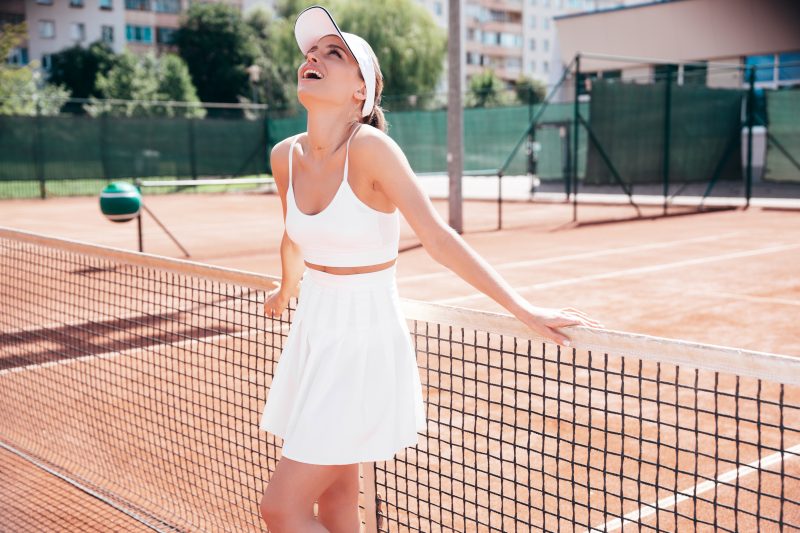
Tennis fashion has infiltrated the mainstream in a way that feels simultaneously unexpected and inevitable. Walk down any fashionable street in New York, Los Angeles, or Paris, and you’ll spot the signifiers: pleated mini skirts that have never seen a clay court, pristine white sneakers untouched by baseline dust, cable-knit sweaters casually tied around shoulders with nary a racquet in sight. The aesthetic has transcended its athletic origins to become one of the most pervasive style influences of the past several seasons—a phenomenon that industry insiders have dubbed “tenniscore.”
But why tennis? Why now? And why has this particular sport managed to cross over into everyday fashion in a way that, say, competitive swimming or basketball haven’t? (Though I’d personally love to see someone attempt grocery shopping in a water polo cap or competitive diving springboard stance.)
The current tenniscore explosion started brewing well before Zendaya’s “Challengers” hit theaters, though that film certainly poured gasoline on an already smoldering trend. The early pandemic saw a resurgence in actual tennis playing—one of the few socially distanced sports that people could engage in safely—which naturally led to increased interest in the associated attire. Brands like Sporty & Rich, Recreational Habits, and Palmes Tennis Society began positioning tennis not just as a sport but as a complete lifestyle aesthetic, one that promised country club elegance without necessarily requiring country club membership.
But that’s only part of the story. Tennis fashion has actually been influencing mainstream style for over a century, from René Lacoste’s revolutionary cotton piqué shirts in the 1920s to Serena Williams’ boundary-pushing catsuits and tutus in recent years. What’s different about the current iteration is how comprehensively it’s been embraced beyond the court—and how it’s being reinterpreted through a contemporary lens.
“Tennis has always had this unique position at the intersection of sport, wealth signaling, and gender performance,” explains Dr. Lucia Trimbur, sociologist and author of “Court Culture: Sport, Style, and Social Distinction,” when I call her to help me make sense of this phenomenon. “The sport historically represented a certain social class and access to leisure time, which translated into a recognizable aesthetic that signaled belonging to those circles.”
In other words, tennis clothes weren’t just functional athletic wear—they were coded markers of privilege, taste, and social standing. Which makes their current democratic adoption all the more interesting.
“What we’re seeing now is a recontextualization,” Dr. Trimbur continues. “People are taking these historically exclusive signifiers and repurposing them, sometimes ironically, sometimes aspirationally. It’s both an embrace and a subtle subversion of what those garments traditionally represented.”
That tension—between traditional codes and contemporary reinterpretation—is precisely what makes tenniscore so interesting as a fashion phenomenon. It’s not just about looking like you belong at the country club; it’s about taking elements of that aesthetic and making them work within contexts that have nothing to do with actual tennis.
I witnessed this firsthand at a recent industry dinner where no fewer than six fashion editors showed up in variations of what could broadly be described as “tennis-adjacent” attire. None were heading to play a set afterward, but all had incorporated elements of the aesthetic—pleated skirts, polo collars, subtle ribbing details, crisp whites contrasted with pops of green or navy—into outfits that read as thoroughly contemporary.
Katherine Wang, my editor-in-chief, wore a Miu Miu pleated mini that referenced tennis silhouettes while being undeniably runway-ready. When I commented on the trend’s prevalence that evening, she shrugged elegantly. “Tennis clothes have always been about controlled precision within specific parameters. Fashion people respond to that tension between rules and expression.”
Katherine’s observation gets at something fundamental about tenniscore’s appeal. Unlike some sports aesthetics that prioritize pure function or aggressive masculinity, tennis style has historically maintained a balance between athletic performance and aesthetic consideration. It’s one of the few sports where the professional uniform already looks like fashion—or perhaps more accurately, where fashion and function achieved a symbiotic relationship early on.
This historical foundation made tennis particularly ripe for crossover appeal. But the current explosion goes beyond just borrowing silhouettes or color schemes from the court. Today’s tenniscore is as much about attitude and association as it is about specific garments.
“The new tenniscore isn’t really about looking like you play tennis,” explains Marcus Williams, creative director at a sports-focused creative agency, when I meet him for coffee to discuss the trend. “It’s about embodying certain qualities associated with the sport—precision, elegance, understated confidence, a certain kind of controlled power. People are drawn to those qualities right now.”
Williams suggests that in our chaotic, often overwhelming cultural moment, the controlled precision of tennis—both the sport and its aesthetic—offers an appealing counterpoint. “There’s something almost meditative about the tennis aesthetic,” he notes. “Everything in its place, lines clearly drawn, a sense of order and tradition that feels grounding.”
This might explain why tenniscore has particularly resonated with younger consumers who came of age during periods of significant social and economic uncertainty. The aesthetic offers a visual framework of stability and tradition—even when it’s being reinterpreted or subverted in contemporary ways.
Zendaya’s performance in “Challengers” tapped directly into this dynamic, portraying tennis not just as a sport but as a complex arena for power, desire, and self-definition. The film’s costume design by Jonathan Anderson cleverly played with tennis dress codes, simultaneously honoring their precision while infusing them with contemporary edge and subtle eroticism. The resulting aesthetic felt both familiar and subversive—traditional tennis motifs reimagined through a distinctly modern lens.
Following the film’s release, fashion search platform Lyst reported a 67% increase in searches for “tennis skirts” and a 34% rise in interest for “tennis dresses.” Racquet magazine, the indie tennis publication that positions itself at the intersection of tennis and culture, saw its subscription numbers nearly double in the month after the film’s premiere.
“‘Challengers’ definitely accelerated interest, but the groundwork was already there,” notes Emma Chao, trend forecaster at a major retail analytics firm, when I call her to discuss the data. “We’ve been tracking steady growth in tennis-inspired silhouettes for about three years now. What the film did was crystallize the attitude and sexiness that was already bubbling under the surface of the trend.”
That sexiness represents a significant evolution from traditional tennis attire, which historically emphasized modesty and decorum. Today’s tenniscore plays with those boundaries, incorporating shorter hemlines, strategic cutouts, and body-conscious silhouettes while still maintaining references to the sport’s characteristic precision.
When I tried to articulate this shift to my mother during a recent phone call, she laughed. “So you’re saying people are wearing sexy tennis clothes to places that aren’t tennis courts? That’s what passes for fashion innovation these days?”
“It’s more nuanced than that,” I protested. “It’s about taking something traditional and making it contemporary and personal.”
Mom, who still plays twice weekly at 65 and owns more actual performance tennis gear than I own shoes, remained skeptical. “In my day, we just called those ‘clothes that aren’t actually functional for playing tennis.'”
Her reaction highlights an interesting tension at the heart of the tenniscore trend: the distance between functional athletic wear and fashion interpretation. For actual tennis players, many of fashion’s takes on the sport might seem impractical or even disrespectful to the activity itself. But fashion has never been primarily concerned with practicality—it’s about communication, identity, and cultural conversation.
The question becomes how to participate in this trend in a way that feels authentic rather than costumey—particularly if your personal experience with tennis is limited to watching Wimbledon highlights while nursing a hangover. How do you adopt elements of tenniscore without looking like you’re wearing a Halloween costume titled “Sexy Tennis Player”?
After examining approximately 600 street style photos, conducting three formal interviews with industry experts, and personally trying on every tennis-inspired garment I could get my hands on, I’ve developed some guidelines for incorporating tenniscore elements into everyday wardrobes in ways that feel modern rather than literal.
Start with a single reference point rather than a head-to-toe court look. A pleated skirt paired with a contemporary knit or a polo-style shirt with jeans creates enough connection to the aesthetic without veering into costume territory. The goal is suggestion, not replication.
Focus on fabric and quality rather than obvious signifiers. The best tenniscore pieces feature precise construction and performance-adjacent materials—crisp cottons, technical knits, structured pleats. These qualities translate the essence of tennis attire without requiring explicit sport references.
Pay attention to proportion and balance. Tennis fashion has always been about the interplay between structure and movement, constraint and freedom. The most successful everyday interpretations maintain this tension, whether through contrasting a fitted top with a pleated skirt or balancing a sporty knit with more tailored bottoms.
Consider color strategically. While tennis whites remain the most recognizable reference, incorporating the sport’s other signature colors (greens, navy, occasional pops of red or yellow) can evoke the aesthetic more subtly. A monochromatic white outfit with just a flash of Wimbledon green in accessories makes the reference clear without being heavy-handed.
Avoid literal sporting equipment unless you’re actually heading to play. The racquet as accessory has appeared on some runways, but in real life, it’s the fastest route to looking like you’re in costume. The exception might be a classic tennis shoe, which has already completed its crossover to everyday footwear.
The most compelling tenniscore looks I’ve encountered don’t replicate tennis uniforms—they translate the underlying principles of the sport’s aesthetic into fresh contexts. Take fashion consultant Jenna Chen, whom I spotted at a recent gallery opening wearing a pleated cream miniskirt with a structured black leather jacket. The contrast between the skirt’s traditional tennis references and the jacket’s urban edge created a conversation between different style languages—exactly what makes fashion interesting.
Or consider stylist Marcus Lee’s approach at fashion week: tailored white shorts with precise pleats paired with an oversized navy knit and chunky loafers. The proportions were thoroughly modern while still nodding to tennis traditions through fabric choice and careful attention to structure.
What these examples share is a thoughtful engagement with tenniscore’s underlying principles rather than surface-level mimicry. They understand that the aesthetic’s appeal lies not just in specific garments but in the values those garments have historically represented: precision, attention to detail, the balance between structure and movement.
Of course, no trend exists in a vacuum, and tenniscore’s rise coincides with broader shifts in how we think about leisure, wellness, and physical presentation. The aesthetic aligns neatly with the “clean girl” and “old money” trends that have dominated social media, all of which privilege a certain kind of understated polish and controlled self-presentation.
These connections aren’t coincidental. All these aesthetics draw from traditions of privilege while recontextualizing them for contemporary audiences. They offer visual frameworks for projecting stability and control in uncertain times—even if that projection is more aspiration than reality for many participants.

This is perhaps the most interesting aspect of tenniscore’s mainstream adoption: the way it reveals our complicated relationship with tradition, privilege, and self-presentation. By engaging with an aesthetic historically associated with exclusivity and wealth, we’re simultaneously embracing and redefining those associations, claiming space within traditions that might once have excluded many of us.
When I finally tried on my mother’s tennis skirt again last month—now perfectly altered to my adult frame thanks to her persistent sewing skills—the experience was different from my childhood dress-up session. The garment no longer felt like a costume but like a connection to both personal and cultural history, recontextualized through my own relationship with fashion.
“You still don’t play tennis,” Mom pointed out as I examined my reflection.
“No,” I agreed, “but I understand the clothes better now.”
She adjusted the pleats with the same care she’d shown twenty-seven years earlier. “The best tennis players understand that looking good and playing well aren’t separate things,” she said. “The precision in the appearance translates to precision in the game.”
Perhaps that’s ultimately why tenniscore resonates so deeply right now. In a cultural moment that often feels chaotic and unpredictable, there’s something powerfully appealing about an aesthetic built on precision, tradition, and controlled expression. We may not all be heading to center court at Wimbledon, but we’re all navigating our own kinds of matches every day—and sometimes, dressing the part helps us play with more confidence.
Just maybe leave the actual racquet at home unless you’ve booked a court. Some lines between fashion interpretation and costume really shouldn’t be crossed, even in the name of commitment to a trend.