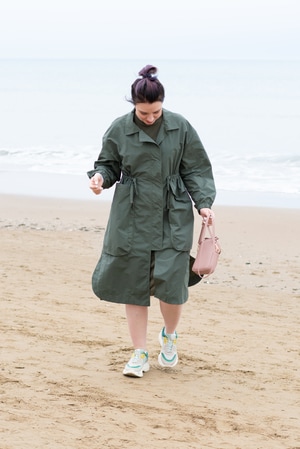
It is interesting to watch British people pack for beach trips. Every time I pack for a beach trip, I find myself adding the most bizarre assortment of items to my luggage – Factor 50 sunscreen and a woolen sweater, flip flops and waterproof boots, a swimsuit and virtually arctic expedition clothing. Britain is a nation of people who insist on enjoying their day at the seaside no matter the weather. In fact, we seem to revel in the opportunity to huddle behind a windbreaker in what can feel like hurricane-force winds.
I learned this the hard way during what I will refer to as my “fashion magazine phase.” That is, that short period after college when I was working an unpaid internship at a glossy fashion magazine where everyone seemed to be ready to set sail for Monaco at any moment. Using this utterly unrealistic reference point, I decided to spend a weekend in Whitstable with my friends from college. Imagine, if you will, me (age 22) packing nothing but flimsy sundresses, completely impractical strappy sandals, and nary a drop of water-resistant anything because I was going to look stylishly chic against the coastal background.
Reader, I nearly froze to death in June.
That is a bit of a hyperbole, but seriously — horizontal rain, temperatures that belonged in November, and there I was dressed in every article of clothing I had packed while shivering like a small, undressed Chihuahua. My friends, who had grown up taking real British seaside holidays, were watching this display with a mix of amusement and exasperation. That weekend taught me that British beach dressing is an art form that has very little to do with the fashion displayed on the French Riviera.
Ever since then, I have become fascinated with the subject — how the type of clothing you wear to the beach depends greatly upon the particular stretch of coastline you are visiting. Honestly, the outfit that looks perfect on Brighton’s pebbles would look completely absurd on the rugged beaches of Northumberland.
Take Brighton for example. It is essentially London-by-the-Sea. Therefore, the beach style of Brighton is very urban. This is not a place for old-fashioned seaside garb — no cute bucket hats or practical walking shoes here. Brighton beach style understands that you will likely be heading straight to a bar or vintage shop as soon as you leave the beach.
And, of course, the pebbles. Those pebbles are essential to understanding Brighton beach fashion. Unlike sand, pebbles really heat up in the sun and walking on them in poor-quality footwear is essentially walking on hot coals. I have seen so many tourists doing this strange hobbling dance across the pebbles in flimsy flip flops, looking like they are walking on actual hot coals. Meanwhile, the locals are gliding across in proper Birkenstocks or those chunky Tevas that were hideous five years ago but are now trendy again, or even Crocs — yes, Crocs, because Brighton has somehow made them fashionable.
My friend Sadie, who has lived in Brighton her entire life, says it best: “You can always tell when someone is a day-tripper. Day-trippers are the ones grimacing their way across the beach while we are simply ambling along, unmolested.”
There is a studied casualness to Brighton beach style that fascinates me. It is fashion-conscious yet not pretentious — vintage Levi’s rather than bland high-street shorts, oversized linen shirts from independent boutiques rather than generic beachwear, interesting sunglasses that imply you may be creative. When there is a major event such as Pride, the beach explodes with colour and creativity; however, on regular Tuesdays, there is far less adherence to traditional beach norms than you would find at other beaches.
As you move along the coast to a place such as Whitstable, the atmosphere changes. You still have that London influence, as Whitstable is effectively weekend retreat central for Londoners, but the overall mood is more laid-back. For example, Breton tops are almost de rigeur at Whitstable, paired with white linen pants rolled at the ankles and canvas espadrille shoes. Everyone carries those wicker basket-type market bags that are ideal for carrying beach stuff, as well as food from the famous food markets.
One of the aspects of Whitstable is that you rarely go to the beach alone. You usually visit the beach, followed by lunch at a seafood restaurant, followed by browsing the local galleries, etc. As a result, you need an outfit that will last throughout the day. You want something that will withstand a bit of sea spray, but not so beach-centric that you’ll look odd sipping Albarino later.
“It’s all about dressing for the entire day and not just for the hour on the beach,” my friend Leila said, explaining her approach to beach dressing. She has this down pat — natural fibres, layering for the wind, and nothing that cannot endure a bit of wind without falling apart.
If you continue eastward along the coast to Suffolk, the beach fashion takes on a totally new personality. Southwold, Aldeburgh, etc. — these are quintessential traditional English seaside towns, albeit with a country-luxury twist that dominates wherever there are expensive second homes. Crew Clothing, Joules, Seasalt Cornwall, etc. – lots of navy blue, tasteful stripes, and that subtle, middle-class sensibility that conveys “We are comfortable, but not showy about it.”
Southwold’s beach huts produce their own mini-culture. Half the fun is sitting outside your hut looking suitably coastal. Therefore, there exists this whole category of beach-adjacent dressing, rather than beach clothing. Real sun hats with brims that may actually shield you from the sun, cover-ups that are destinations, rather than just articles to be thrown over swimmers, and always, always layers for when the East Anglia weather inevitably turns.
Cornwall is an entirely different animal, especially where there is a significant surf culture. Newquay is all about technical gear — decent wetsuits from brands like Finisterre, swimwear designed to remain in place while being battered by waves from the Atlantic Ocean, and a collective attitude that the beach is for doing things, rather than merely looking pretty.
My friend Tom moved to Cornwall from London five years ago and has developed a keen eye for spotting locals vs. tourists. “The serious surfers appear completely unruffled by whatever the weather throws at them,” he said. “They wear proper wetsuits regardless of the time of year, use boards that are clearly well-used, and buy their gear from local surf shops rather than whatever Zara calls beachwear this season.”
Even if you’re not surfing, Cornwall promotes an active, adventurous approach. Everything is quick-drying, technical sandals that can handle rock pools and coastal path walks, and lightweight layers that fit into backpacks. There is significantly less “Let me pose for Instagram” and more “Let me be adequately prepared for whatever the Atlantic decides to do today” – and given Cornwall’s location, the possibilities are endless.
In terms of its surf culture, the northern Devon coast shares similarities with Cornwall but has its own identity. Woolacombe and similar areas combine classic British family-holiday vibes with more adventurous pursuits. You will see children wearing bucket hats alongside serious surfers in full technical gear, as well as families with dogs wearing bucket hats. Similarly, walkers in South West Coast Path attire can be seen walking along the cliff tops.
My cousin Rachel has been vacationing in northern Devon every year with her family for years and has developed a systematic approach. “The beaches themselves can be lovely if it is sunny, but getting to the beaches typically requires steep paths where you will be hit head-on by the wind. Therefore, we always pack for the worst case scenario.” Lightweight layers that can be wrapped around waistbands, sweatshirts that can fit into backpacks, and footwear suitable for both sandy beaches and occasionally muddy access roads to beaches.
Welsh beaches – Pembrokeshire, the Gower Peninsula, etc. – are stunning but command respect. My Welsh friend Rhian has no tolerance for inadequately preparing for Welsh beaches. “These beaches are wild and beautiful, but the weather can turn on a dime. You need to be prepared for that.” Thus, serious waterproof jackets are the norm, rather than token windbreakers. Walking shoes that can handle beach terrain and muddy coastal paths are a must, and always, always layers for when the East Anglia weather inevitably turns.
Additionally, the strong outdoor recreation culture in Wales influences beach attire as well. Beach excursions frequently combine with coastal path hikes or other activities, thus you see a lot of technical clothing – serious outdoor brands like Rab and Mountain Equipment are commonly seen on summer days. Additionally, wild swimming is extremely popular in Wales, and therefore dryrobe-style changing robes, swimming shoes for entering rocky waters, and all this specialized cold-water gear that prioritize functionality over any traditional notion of beach fashion are common.
Finally, the beaches in Northumberland are on an entirely different scale. Bamburgh, with that fabulous castle and miles of sand, is breathtaking, but bloody hell, it can be harsh. Even on a warm summer day, if the wind is blowing in off the North Sea, it can feel like winter. Thus, people tend to dress for it – layers, windproof gear, etc. There are plenty of serious walkers hiking the coastal paths, families with large, elaborate windbreak systems for multi-hour treks, and hardened swimmers in wetsuits regardless of the season. And, of course, there are plenty of dogs everywhere, which introduces a practical aspect — treat pouches, shoes that can handle both sand and mud, clothing that can withstand enthusiastic post-swim shaking.
Scotland’s beaches represent the ultimate expression of our national ability to optimistically dress for a day at the coast. On a perfect day, a place like Luskentyre on Harris can rival any tropical paradise, and the locals take full advantage of it, although never recklessly. “There is always an element of being prepared for the weather,” my Scottish friend Isla said. “Even on the most pleasant day, people carry layers, windbreakers, and sometimes thermoses. We understand how quickly it can change.” Therefore, swimwear is often layered under additional layers, footwear is practical rather than stylish, and cover-ups provide actual warmth, not just modesty.
Wild swimming is also a major movement in Scotland, and as such, it generates a great deal of specialized cold-water gear – dryrobe-style changing robes, neoprene gloves and boots, and true swim caps. As a result, this functional approach to beachwear extends beyond wild swimming to general coastal attire.
What is so great about all of these regional variations is that they are formed based on the physical characteristics of each beach, as well as the social context surrounding it. Pebble beaches require different types of footwear than sandy beaches. Urban beaches that are close to bars and restaurants require attire that can be transferred from sand to social settings. Coastal beaches that promote activity-based pursuits encourage more technical and performance-based clothing.
Regional variations also exist seasonally. The clothing styles that are typical of British beaches in high summer are vastly different from those that are typical of the same beaches in spring and autumn, when the primary users of the beaches are generally dog walkers, outdoor enthusiasts, and locals. Winter, of course, completely redefines the beaches, as wild swimmers in full cold-water gear, walkers bundled against the elements, and photographers seeking moody seascapes, etc. can be seen.
My own approach to beach packing has changed dramatically since that terrible weekend at Whitstable. Today, I always pack layers regardless of forecast, shoes that are suitable for the specific type of beach surface, a sturdy hat that won’t fly away in the first gust of wind, and always – always – windproof gear that is readily accessible. I also cheque the strength and direction of the wind, not just the temperature, because the wind can rapidly change a perfect beach day into an endurance challenge in mere minutes.
Additionally, I have come to appreciate the various personalities of the regions, and adjust my approach to beach dressing according to the region. Brighton receives more urban pieces of clothing that work from beach to bar. Cornwall receives more technical and performance-based clothing that will handle coastal walks or spontaneous attempts at bodyboarding. Northumberland receives sufficient layers to withstand an unseasonable blast of Arctic air from the North Sea.
While British beach holidays may necessitate more planning and forethought than their Mediterranean counterparts, there is a unique beauty to our determination to enjoy our coastlines regardless of the weather. While we may not have guaranteed sunshine, we have some of the most diverse and beautiful coastal scenery in the world — and as long as you have packed correctly, there is truly joy to be derived from a British beach on a day with bad weather.
Just remember to bring the thermos. Even in August.