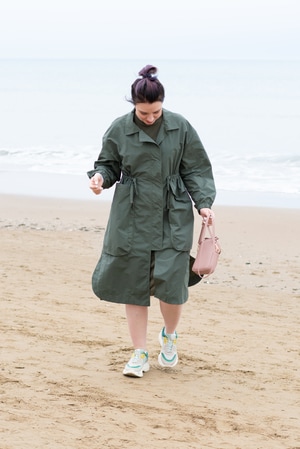
You know that feeling when summer says goodbye, and you’re standing outside in what seems like an entirely new climate? Yeah, that happened to me recently. One day I’m whining about how hot the Max Train is; the next, I’m freezing at the bus stop in a sundress like some kind of seasonal amnesia victim. Weather in Portland is bizarre, but at least it’s reliably bizarre – unlike when I lived through “real” British autumns while studying in Edinburgh. That experience essentially bonded me to the idea of using layering correctly — although it would take years to actually implement what I’d learned.
For years I’ve been awful at transitioning into seasons. I was catastrophic. My junior year of college, I was still wearing flip flops in November, as I was in denial regarding the necessity of closed-toe shoes. Plus, I couldn’t afford boots. I remember a particularly embarrassing October morning when I arrived at my internship drenched, as I had decided a light drizzle wouldn’t warrant the use of an umbrella. My supervisor looked at me dripping in the lobby and told me to head home to change. Embarrassment does not even come close to describing the humiliation.
However, here’s the thing I realised over many years of being ridiculously wrong, and learning from people who were smarter than me — the purpose of layering in Autumn isn’t merely to stay warm. Layering in Autumn creates a system that will allow you to stay warm regardless of whether you are broke, the weather can’t decide what to do, and you want to appear somewhat presentable despite only owning approximately three good outerwear pieces.
The popular phrase “Invest in quality basics”? That’s wonderful if you have trust funds, but most of us are operating on a Target budget and attempting to create the illusion of intention. I have spent the last five years refining what I call the “broke person’s layering system,” and to be honest, it’s better than a number of the expensive systems that fashion influencers tout.
My approach to base layers is relatively straightforward — I live in these ribbed long sleeve tops from Uniqlo’s Heattech line. Each one costs roughly $15, and they genuinely keep you warm without making you look bloated. None of the cheaper versions I own of thermal layers retain their shape after a few washes, whereas the Uniqlo ones remain intact. I purchased five of them in neutral colours during an end-of-season sale two years ago, and they continue to perform well. My friend Rachel laughs at me for wearing “Old Lady Thermals,” but it is she who is perpetually cold in her crop tops. So I am not asking for fashion advice from her.
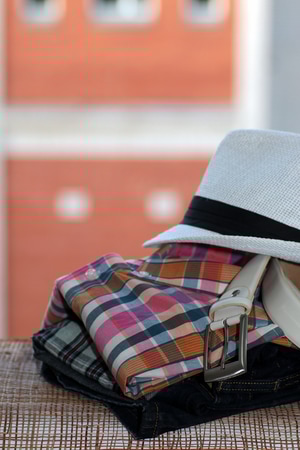
Next goes what I call the “Personality Layer.” This is the item that gives the impression that you selected your clothing deliberately and not simply pulled off whatever was cleanest. In my case, this is usually a thrifted button-down (I have an addiction to finding men’s Oxford shirts at Goodwill — they are of better quality and cost the exact same $4 as women’s shirts) or one of my two good sweaters. And I mean two literally. I have a charcoal wool pullover from COS that I saved up for and purchased full price like three years ago. And a cream colored cashmere cardigan my mother purchased for me years ago that is older than I am yet still remains ideal. When you only possess two excellent sweaters, you become extremely deliberate about when to wear each.
This is where things get complicated — the outer layer. This is where you require an item that performs, but doesn’t look like you are preparing to ascend Mount Everest. I wasted several years cycling through inexpensive jackets that either failed to keep me warm or disintegrated after one season. I ultimately broke down and purchased a real wool coat. Honestly, it was economically painful — I placed it on my credit card and survived on ramen for at least two weeks — however, it has paid itself back tenfold. It is this classic double breasted style in Navy Blue that complements anything. Wearing it makes me feel as though I have my life in order, even though I most assuredly do not.
There’s something nobody advises you about constructing a layering system on a budget — accessories are your secret tool. A good scarf can completely transform a standard outfit. If you are astute in shopping, you can purchase incredible scarves secondhand. My best thrift store find to date is this enormous plaid wool scarf that somebody likely received as a gift, and therefore never wore. It cost me six dollars, and it has raised the level of every autumn outfit I have worn for the previous three years. Strangers have even stopped me and asked me where I acquired it. I simply smile enigmatically.
For a long time, the footwear situation stressed me out. Boots that look cute are expensive. Practical boots are ugly. Waterproof boots are both. I eventually solved this dilemma by realising I required at least two sets of boots — one that looks good, and one that actually functions. My “looks good” boots are these ankle boots from Zara that I purchased on sale, and I have now resoled them twice since I wear them so frequently. My “actually functions” boots are these completely unattractive waterproof hiking boots I purchased at REI during their members-only sale. Are they compatible with my carefully curated aesthetic? Absolutely not. Do they keep my feet dry throughout Portland’s perpetual drizzling months? You bet they do.
I learned the hard way that attempting to make one pair of shoes function for every weather condition is a formula for failure. Last year I destroyed a pair of suede ankle boots by wearing them in the rain once. One downpour and they went from “cute ankle boots” to “sad, water damaged shoes that make squelching noises.” I attempted every internet hack to restore them — the blow dryer technique, newspaper stuffing, even that bizarre steaming method someone claimed to work on TikTok. Nothing worked. They currently reside in my closet as a $80 reminder to cheque the weather forecast.
The thing about layering that I struggled to understand is that it is not merely about temperature — it is about versatility. Portland weather is capricious. It may be sunny when you depart for work, raining by lunchtime, and inexplicably warm by happy hour. Possessing a system that allows you to add/remove layers without appearing as though you are experiencing a wardrobe meltdown is essential, especially when you spend your days in different climates.
My coworker Jess is a genius when it comes to this. Regardless of the weather, she consistently appears impeccably dressed. I finally requested her secrets. She explained that she cheques the hourly forecast each morning to plan her layers, and that she maintains a cardigan and umbrella at the office year-round. While it may seem excessive, I can attest that she is never the one shivering in the break room or sweating walking to lunch. Therefore, I suppose we could all learn from her example.
The texture game is the area in which you can truly make budget layering appear expensive. Incorporating a variety of fabric types and weights contributes to visual interest when working within a limited colour palette (as most of us are when shopping secondhand and attempting to make everything work together). I have developed a knack for discovering interesting knits at thrift stores — chunky cardigans, cable knit sweaters, and even the occasional cashmere sweater that someone donated without realising what they possessed.
At the moment, my preferred layering configuration is one of those Uniqlo base layers, a vintage flannel shirt I located at Buffalo Exchange, and my excellent wool coat. It may appear simplistic, but the flannel has an incredible worn-in softness and the colours complement the navy coat perfectly. The total cost of this outfit was less than $100, but it appears to be far more expensive than that. The trick is ensuring that everything fits well — even affordable clothing appears superior when properly sized.