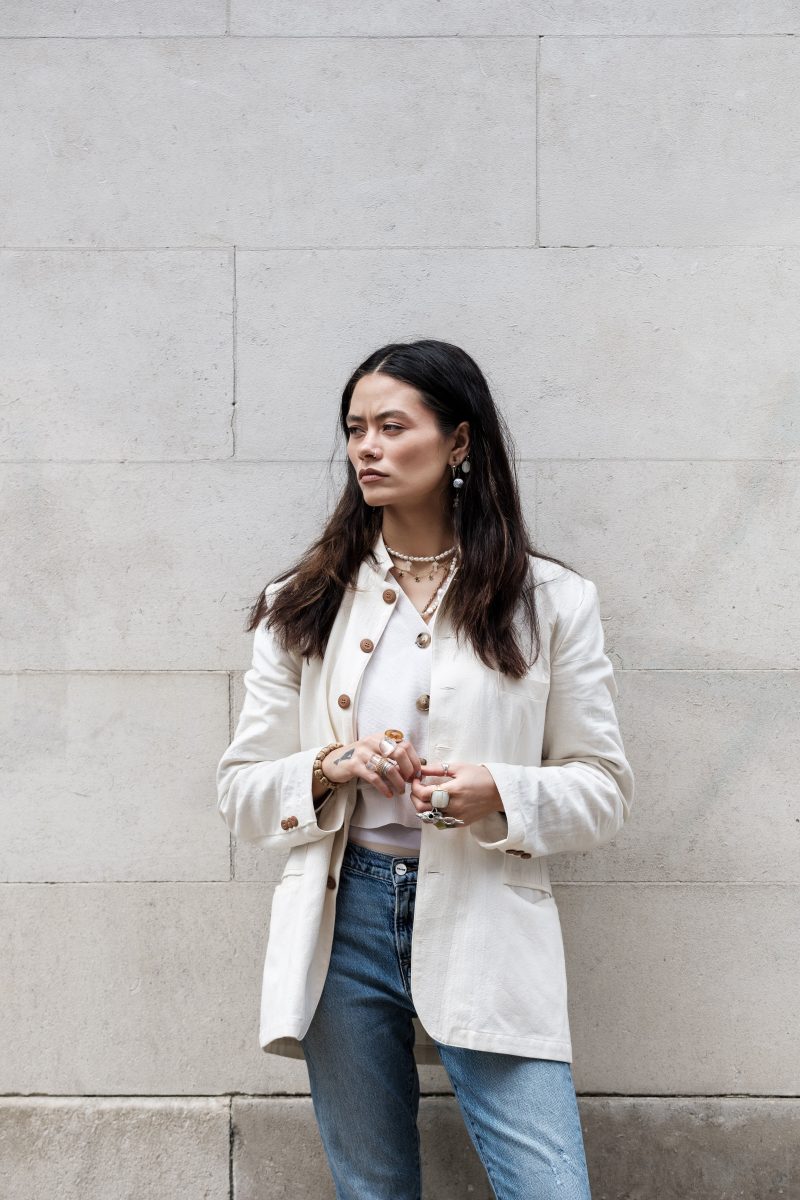
I have a confession that’s going to sound hypocritical coming from someone who writes about supporting ethical fashion – I have a serious problem with French brands. Not ethically necessarily, though that’s definitely complicated too, but more like… I can’t stop buying from them even though I genuinely believe British fashion deserves more love. It’s embarrassing, honestly. Last month I literally lectured my friend about supporting local designers while wearing a Sézane blouse I’d ordered the night before in what I can only describe as a wine-fueled moment of weakness.
The thing is, this isn’t just my personal failing – it’s basically endemic in British fashion circles. I notice it constantly when I’m at industry events or scrolling through fashion editors’ Instagram stories. There’s this predictable pattern where everyone suddenly starts dressing “extremely French” whenever Paris Fashion Week approaches. Out come the perfectly cut blazers, the effortlessly chic silk scarves, those basket bags that somehow look sophisticated instead of like you’re about to do your weekly shop at Waitrose.
My friend Sarah, who works at a fashion magazine, actually created a bingo card for this phenomenon last season. Items included “Breton stripe,” “red lipstail with otherwise bare face,” and “wearing a beret unironically.” By day two of Paris Fashion Week coverage, she’d basically won twice over just from her colleagues’ outfit posts. We all laughed about it, but honestly? It made me realize how deeply ingrained our obsession with French style really is.
This whole thing has been bothering me for months now because it goes against everything I supposedly stand for. I write about supporting local production, about understanding where your clothes come from, about the environmental benefits of shorter supply chains. And yet here I am, consistently choosing brands that have to ship across the Channel when there are perfectly good British alternatives right here. The cognitive dissonance is… well, it’s a lot.
But I’ve been trying to figure out why this happens, not just for me but for basically every fashion-conscious British woman I know. What are we getting from French brands that we don’t think domestic ones provide? And more importantly, are there British labels that actually outshine their French counterparts that we’re overlooking because we’re too busy being seduced by that supposed Gallic je ne sais quoi?
The most obvious category where French brands win me over completely is what I call “elevated basics.” You know – those seemingly simple pieces that somehow look infinitely more sophisticated than anything you can find on the British high street. I have this white Sézane shirt that I bought two years ago (after months of telling myself I didn’t need another white shirt) and it’s honestly transformed how I think about basics. It has no obvious design features that make it special – no unusual collar, no statement details, nothing trendy that will date it. But it hangs perfectly, makes everything I wear it with look more expensive, and has survived countless washes without losing its shape or developing that sad, tired look that most white shirts get after a few months.
For comparison, I bought what looked like an almost identical shirt from a British high street brand around the same time. It cost about a third of the price, which felt very sensible and aligned with my values about not overspending on basics. That shirt lasted exactly six washes before it started twisting at the seams and developing a weird fit that made me look like I was wearing my teenager’s school uniform. The Sézane one still looks pristine. The cost per wear calculation is honestly embarrassing – the French shirt has been worth every penny while the British one is now relegated to painting duty.
Denim is another area where I consistently find myself reaching for French brands despite knowing I should probably support British manufacturing. A.P.C. jeans are basically a cliché at this point – every fashion editor owns at least one pair, and I’m definitely part of that statistic. But there’s a reason they’re so popular. They get that higher rise that actually flatters real bodies, they’re cut straight through the leg without being baggy, and they’re structured enough to hold you in without requiring engineering equipment to get them on. British denim brands tend to either do great fashion-forward styles that look fantastic but feel like wearing cardboard, or comfortable basics that are incredibly unflattering. The French somehow manage both style and wearability.
I have three pairs of A.P.C. jeans now (I know, I know, it’s excessive) and they’re all slightly different cuts that I’ve accumulated over the years. Each one fits better than any British jeans I’ve tried, and I’ve genuinely tried a lot. There’s something about the proportions that just works better for my body type. Maybe it’s that I’m more similar in build to French women than I thought, or maybe French brands just understand the female form in a way that British high street doesn’t always manage. Either way, the evidence is in my wardrobe and it’s pretty damning.
The contemporary French brands – your Sandros, your Majes, your Ba&sh labels – have also completely seduced me despite being exactly the kind of premium high street that I should theoretically be skeptical of. These brands sit in this sweet spot of “achievable aspiration” that British equivalents somehow miss. They feel special and luxurious without requiring an actual trust fund, and they do that smart-casual crossover that I find incredibly useful for my actual life.
Like, I have this Sandro blazer that I probably wear twice a week. It works for client meetings, for dinner out, for basically anything except very formal events or actual exercise. British brands at this price point often feel either too casual for work or too corporate for real life. This blazer somehow bridges that gap perfectly, which makes the higher price point feel justified because I’m essentially getting multiple wardrobes in one piece.
Accessories are probably where my French obsession is most embarrassing though. I spent six months saving up for a Polène bag last year, despite being surrounded by great British accessories brands through my work. But there’s something about French accessories that hits this perfect balance of timeless and contemporary that I find irresistible. They’re never showy but they’re always noticeable to people who know what they’re looking at. It’s like fashion semaphore for people in the know.
My Polène bag is the kind of thing that most people wouldn’t give a second glance, but anyone in fashion immediately clocks it. There’s something powerful about that kind of subtle recognition – it signals membership in a club that values discernment over flash. Which sounds incredibly pretentious when I write it out like that, but it’s honestly how it feels when I carry it.
But before this turns into a complete French love letter that completely undermines everything I claim to believe about supporting local industry, let me talk about where British brands absolutely dominate in my wardrobe. Because despite my periodic Gallic weaknesses, there are definitely categories where I’m stubbornly, proudly domestic in my buying habits.
Tailoring is the big one. While French blazers get plenty of love from me, when it comes to proper suits or more formal tailored pieces, British expertise wins every time. French tailoring often looks fantastic but it’s cut for a different body shape – generally more petite than most British women. British tailoring just fits better on my actual body. I swear by brands like Reiss for work suits and The Fold for more structured pieces, and they understand the reality of British female bodies in a way French brands don’t always manage.
There’s also the practical consideration that British tailoring is designed for British weather. French suiting tends to use lighter fabrics that might be perfect in Paris but are completely useless in Manchester in November. Given that I spend a significant portion of my life feeling slightly damp from unexpected rain, this isn’t a small consideration. My British blazers are substantial enough to provide actual warmth and weather protection, not just style.
Knitwear is another area where domestic loyalty runs deep for me. British knitwear is just better – we have centuries of wool production and knitting heritage that shows in the quality. Why would I buy a French jumper when I can get one from a Scottish mill that will literally outlive me? My Johnstons of Elgin cashmere jumpers are approaching their fifth year of regular wear and still look perfect. The French cardigan I bought in a moment of weakness (okay fine, I have one) is nice, but it’s not the same quality and honestly makes me feel like I’m betraying my principles when I wear it.
Outerwear, particularly rainwear, is where British superiority is most obvious. My Barbour jacket is approaching its tenth birthday and still keeps me completely dry in weather conditions that would challenge Noah. French coats look beautiful but they’re designed for gentle Parisian drizzles, not the horizontal rain that characterizes British weather six months of the year. There’s no contest here – British outerwear brands understand what we actually need from our clothes.
Then there’s the category of British brands that I support partly out of genuine love and partly out of professional responsibility. Smaller independent designers like Rejina Pyo, Rixo, and Molly Goddard feature heavily in my “special occasion” wardrobe – pieces I bring out for industry events where supporting British talent feels important. I could wear French designers to British Fashion Week, but it would feel wrong somehow. Like showing up to a family gathering wearing your rival’s team colors.
The most interesting development has been British brands that seem to have absorbed the best aspects of French style philosophy while maintaining distinctly British sensibilities. Toast, Jigsaw, and Whistles create clothes with that French-inspired understated elegance but designed for British bodies, weather, and actual lifestyles. They’re like the fashion equivalent of speaking fluent French with an English accent – recognizably influenced but fundamentally our own.
What’s become clear to me through all this wardrobe analysis is that my buying habits are as much about identity as they are about actual clothing needs. The French pieces let me temporarily step into a different version of myself – one that’s perhaps more polished, more effortlessly chic, more Julie Delpy in Before Sunrise than I naturally am. They’re like a fashion holiday from my regular personality.
The British pieces reflect both practical realities (our weather, my actual body shape, my real life rather than my idealized one) and a sense of cultural connection and responsibility. They’re the sartorial equivalent of coming home after that holiday – maybe less romantically aspirational, but comfortable and familiar in the best way.
My everyday uniform reflects this perfectly. Most days I’m in British brands – Whistles dresses that have survived years of regular wear, M&S cashmere that punches way above its price point, jeans from small British labels that actually fit my decidedly un-Parisian proportions. But for important meetings or industry events, I find myself reaching for my French pieces – the Sézane blouse I spent too much on but never regret wearing, those A.P.C. trousers that somehow make my legs look longer, the Rouje dress that never fails to generate compliments.
The sustainability angle makes this all more complicated, obviously. French brands aren’t inherently less ethical than British ones, but the shipping distances are longer and I’m definitely not supporting local manufacturing when I order from Paris. Some French brands are actually doing interesting work on sustainability – Sézane has started some secondhand programs, A.P.C. does repair services. But it’s still harder to verify their supply chains and labor practices than it would be with domestic brands.
I’ve been trying to be more intentional about this lately. When I want that “French girl” aesthetic, I’ve been looking for British brands that capture similar vibes first. COS (technically Swedish but with a strong UK presence) does great elevated basics. Arket has that minimalist French-inspired feel. Even & Other Stories, though H&M-owned, produces some pieces that scratch the same itch as my beloved French brands but with shorter supply chains.
But I’m also trying to be realistic about this rather than beating myself up for not being perfect. The French pieces I own are all things I genuinely wear regularly and plan to keep for years. They’re not impulse purchases or trend pieces – they’re investments in my professional wardrobe that happen to come from across the Channel rather than from British brands. The cost per wear on most of them is actually quite good at this point.
The most honest assessment probably came from a fashion editor friend who’s been in the industry for decades. When I was agonizing about this whole French versus British loyalty question, she looked at me and said, “We buy French when we want to be someone else for a bit, and British when we’re comfortable being ourselves.” Looking at my own closet, it’s hard to argue with that observation.
Maybe the answer isn’t to completely eliminate French brands from my wardrobe in some purist gesture toward supporting domestic fashion. Maybe it’s about being more conscious about when and why I’m choosing them, making sure the British brands I do buy from are ones I genuinely believe in, and being honest about the fact that sometimes we all want to cosplay as slightly more sophisticated versions of ourselves. As long as I’m not abandoning British fashion entirely in favor of some idealized French aesthetic, perhaps a little cross-Channel shopping isn’t the worst thing in the world.
The key is probably balance and intentionality rather than mindless consumption driven by romanticized ideas about French style. And maybe, just maybe, occasionally wearing that Sézane blouse while championing British designers isn’t the end of the world – as long as I’m honest about the contradiction and working to support domestic talent in other ways too.

Riley’s an environmental consultant in Seattle with strong opinions on greenwashing and fast fashion. She writes about sustainability without the guilt trip—realistic tips, honest brand talk, and a reminder that progress beats perfection.